
PSI Bulletin: November 2023
No. 11/23 SUBSCRIBER EDITION: please go to potatostorageinsight.com/subscribe to sign up as a Synopsis subscriber. Most of our bulletins are fully accessible only to our subscribers.


Welcome to our November subscriber edition of Synopsis, PSI's latest update featuring news and technical titbits on potato storage.
First of all, a reminder if it has somehow passed you by, that BP2023, the latest biennial landmark for the potato industry, takes place in Harrogate on 22/23 November. We will be on Stand 135 and hope to see you there. We'd very much welcome feedback on the first two years of PSI and Synopsis... plus there's a prize for every visitor to our stand!
Unfortunately, the tail on this year's harvest is going to be a long on with far too many acres remaining in the ground as we move into the beginning of winter. For the third month in a row, we are devoting our Best Practice feature for November to more in-depth information on dealing with wet crop. With many fields unavoidably waterlogged to one degree or another, it is going to make storage for any period at the least challenging and more likely almost impossible for any crop that has spent any amount of time encapsulated in water.
Along similar lines, this month's Technical Insight goes back to basics providing more information on the disease that causes huge losses to potato crops across the world: bacterial soft rot.
It is a disease you can't be complacent about and having experienced some unmitigated disasters in a few stores in recent years, it is perhaps worth re-stressing the key messages for dealing with this bacterial infection that can rapidly overtake any attempt to control it.
Also appearing on the horizon, in addition to a few dry rot outbreaks from early warm harvests, are a number of internal defects so please ensure you do some QC checks before committing to long term storage...
Finally, a reminder that, for detailed technical advice, there still remains the option to access the AHDB archive online or you can speak to Adrian at PSI on 07970 072260.
POTATO STORAGE INSIGHT (PSI) ACTIVITY
Industry initiative progress
Work at PSI has continued on the SPoT storage initiative outlined last month. The project will include a storage open day with exhibition space for partners in May 2024. Our first technical workshop meeting for the project will be held on Tuesday 5th December at the Wisbech Rugby Club, Chapel Road, Wisbech. PE13 1RG. Places can now be booked through GB Potatoes: register at www.gb-potatoes.co.uk/events. There's more detail below.
If you are a commercial supplier involved in storage and would like to hear more about becoming a partner in the initiative, please email adrian@potatostorageinsight.com or call Adrian on 07970 072260. We have some great offers on stand space for the project open day to tempt you with and speaker slots at a range of events for signed-up partners. More below.
During the past month, we have also been to look at some low-cost energy monitoring systems which are in extensive use on a farm running multiple enterprises in Herefordshire and neighbouring counties. This is a special interest area at the moment: it is crucial that more growers and store managers become more familiar with the technology that now exists to monitor consumption and costs on a store-by-store and even an item-by-item basis. Those growers who have already taken the plunge are learning a huge amount about the way their stores work and, combined with management of cost-saving devices such as inverters, are making extremely significant savings on their store running costs that can be the difference between making a margin or not.
We have also been getting ready for our trip to the BP2023 event at Harrogate. The show will be held at the Great Yorkshire Showground site on 22 & 23 November. Click here to register in advance for free entry. We hope to see you there!
A quick reminder: you can find us on Stand 135 in Hall 1. Do come and have a chat! We will have information available about our various services and some new announcements about future activities, including our 2024 Potato Store Managers' Course information. And all our show visitors are guaranteed to win a prize!
Don't forget that PSI will also be contributing to the seminar programme at 12.45pm. PSI's Adrian Cunnington will be speaking on energy efficient management of stores and will also chair the session on optimising use of sprout suppressants. This session will feature the PPA's expert technical panel of Jeff Beever (McCain Foods), Gary Collins (Pepsico) and Richard Baines (Lamb Weston).
BEST PRACTICE for November/December
With this year’s harvest becoming a very, very drawn-out affair for some, here are some tips for dealing with those crops making it into the store somewhat later than advertised…
The first thing to say is that there is no point in trying to store rained-on, soaked or waterlogged potatoes for anything other than a minimal period of time. It only takes a matter of few hours of anaerobic conditions (ie those where oxygen is excluded) for breakdown from bacterial soft rot (Pectobacterium spp.) to set in and the keeping quality is lost. Look for tell-tale signs such as inverted lenticels (lenticels are the skin pores through which oxygen is taken into the tuber) or the characteristic pungent smell of bacterial breakdown to identify the highest risk crops.
Anything where oxygen has remained available might be salvageable through batch drying but the key is to dry the potatoes as fast as possible to cut down the time during which anaerobic conditions can prevail. Even then, a seemingly dry tuber could still be “drowning” if the lenticels have become clogged with water due to the crop being rained-on.
To dry the wettest crops, use any type of forced ventilation at your disposal. If there is a bulk store floor available, stack crop at a modest 1 metre high across the floor and blast dry the pile with the maximum amount of air available. Consider tactics such as closing off laterals to focus airflow onto the wettest crop if necessary.
In boxes, try to stack against a drying wall or letterbox if there is one available and plug the pallet slots with foam to force air through the potatoes. Consider using temporary fans too but remember that air takes the path of least resistance so it will bypass the potatoes if it is easier for it to do so.
Once a batch is dried - that means all the surface moisture has been removed – move the crop to an area where it can be held in boxes or in bulk to free up the forced ventilation space for the next tranche of crop coming in. Be realistic on expectations with stack depth or how much you fill boxes, especially if there is a high soil content as loose soil will quickly impose a much greater back pressure thereby reducing the airflow rate.
The test of such as system is whether or not there is enough drying capacity and/or handling capability to turn the crop over quickly enough to keep pace with intake.
If soft rot does start to appear, make an assessment of the extent of the rot. Just counting 100 tubers on the top of a box is an easy way to do it; try to be random in your selection of crop. Even a 1% incidence of soft rot can quickly become messy; it will need some rapid drying to control. Don't contemplate storing crops with more than 1% soft rot.
Within reason, pay attention to temperature as handling cold crop will cause damage and bruising and blowing high volumes of air through potatoes will lower their temperature due to the loss of latent heat during the evaporation of water. Remember too that, when crops get cold, the rate of curing (damage repair) reduces dramatically and risks of diseases such as gangrene and skin spot can rise, especially in sensitive varieties.
Sprout suppression: fogging gets underway
Also this month many crops are likely to need to be treated for the first time with a sprout suppressant if they haven't had one already. Make sure that you carry out regular inspections so that you can optimise the treatment timing, not forgetting to allow time to equalise temperatures beforehand. And please don't forget that any chemical treatment of a potato crop needs signing off by a BASIS-qualified advisor. It is illegal for it not to be.
Hopefully most crops will have received maleic hydrazide, where appropriate, which should provide some protection against early dormancy break in store.
Within the store, there are now a variety of differing products that offer different options for sprout suppression but it is important to understand the relative merits and downsides of each product.
The biggest problems we see with the new generation of contact products like DMN, spearmint oil or orange oil is that failure to pay attention to detail can result in crop damage. Make sure crops are dry before application. And use the store fans (without cooling) to even out the temperatures for a good 24 hours before the chemical goes on. Make sure there is plenty of room within the store next to the application point for fog to move away into the building. If it can’t there is a high risk of over-saturation of product and liquid fall out on to the crop that can lead to scorch.
In stores where ethylene is being used for sprout control, keep the store tightly closed to prevent loss of the gas (it is a very small molecule so is easily lost) and rely on a regulated flushing system - either manual or automatic - to manage the CO2 level. Remember ethylene is a plant hormone so try to manage its use carefully and gradually; a sudden surge is likely to elicit a very abrupt response from the crop, which is never a benefit.
If, as we move through the storage season, you'd like to discuss how best to handle a particular scenario or get some advice on how your store management strategy can be strengthened, please call Adrian Cunnington at PSI on 07970 072260.
TECHNICAL INSIGHT
Soft rot (Pectobacterium carotovorum)
In tubers, bacterial soft rot (BSR) can start from infected wounds, lenticels and stolon ends. Waterlogging will typically initiate the rot in the lenticels (breathing pores). Symptoms of soft rot typically include the development of soft, wet, cream-colored tissues. Diseased tissue is sharply demarcated from healthy tissue and sometimes has darker margins (below). It has little odour when first infection takes place but will darken and develop a foul smell as secondary organisms grow in the rot.
Because it is a bacterial infection (as opposed to one caused by fungi), the infection can develop incredibly quickly. Bacteria multiply exponentially so a minor infection can soon become a major one.
Development of soft rotting is aided by (a) moisture and (b) warmth. So, to minimise a BSR infection, it is necessary to (a) dry the crop as thoroughly as you can and (b) cool the crop to as low a temperature as possible. See Best Practice advice above. It should also be appreciated that rotting generates quite a lot of heat so this can quickly create condensation in the crop and the two factors combined can then encourage the rot to develop further.
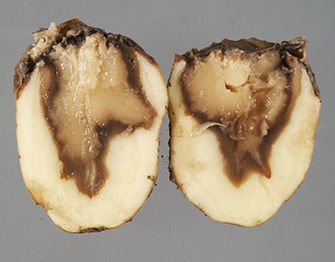
The bacteria might also sometimes be present without any obvious symptoms (latent infection) until suitable conditions for disease development occur.
SPot STORAGE PROJECT FULLY UNDERWAY
First Strategic Potato (SPot) Stores established
The new project we touched on last month to help fine-tune storage practices is now fully underway with a consortium of GB Potatoes, storage specialist Adrian Cunnington of Potato Storage Insight, and agronomist Simon Faulkner from SDF Agriculture at the helm.
The first SPot Stores have been chosen with some of the potatoes loaded being used for trials. The project's first grower workshop/meeting will be held in Wisbech on 5th December.
Industry partners involved in the storage sector are being encouraged to sign up to the project, which has been based on the Strategic Potato (SPot) Farms model formerly run by AHDB Potatoes. Newly signed-up to the cause are NFU Energy, Safestore/Biofresh and Potato Storage Treatments along with store hosts Winters Lane Storage and S&S Pugh. Welcome aboard everyone!
There are also plans for an Open Day to be held in May 2024. Growers and their advisers attending the open day will get to see the set-ups and then return to find out how practices are developed and refined over future seasons.
“Currently there is a lack of practical research in storage, and very limited funding available for any R&D. However, rather than revisiting old trial results on paper, we believe that practical activity will help growers better understand how to refine their own storage facilities’ performance,” says Adrian. “Working together to build better practice will help improve returns as we will be monitoring costs such as energy.”
“These trials will demonstrate the contrasts of what can happen with a range of varieties subjected to different strategies, and with some of the currently available sprout suppressants.
“To be sustainable and make a realistic margin, potato stores need to be profitable, so tuber quality needs to be good and costs transparent and controlled.
“Seeing things done in a commercial set-up helps our hosts and partners share experiences with visitors who can then go home and confidently apply them in their own stores.”
Learnings from the SPoT stores will also be shared at other workshops which are being planned by GB Potatoes in Yorkshire, Shropshire and Scotland during 2024.
Mark Taylor, GB Potatoes Chair, says: "At GB Potatoes we are committed to supporting work to on potato storage strategies, with knowledge being shared across the industry. Our work will focus on ‘practical solutions’ which have the potential of immediate impact.
“Workshops, together with demonstration sites, will bring our industry together to share best practice and consider simple changes to refine farm practices.”
In addition, PCN-resistant varieties are being stored in two south Lincolnshire stores for additional evaluation. This follows the successful first year of field demonstrations held in conjunction with SDF Agriculture and Hutchinsons.
SDF Director Simon Faulkner says: “This will assess the storability of useful PCN resistant varieties that are set to help growers’ develop an effective strategy against PCN.”
The workshop on 5th December has the following speaker line up and more details are available online:
Mark Taylor, GB Potatoes
Adrian Cunnington, Potato Storage Insight
Simon Faulkner, SDF Agriculture
Roger Stones, NFU Energy
Register at www.gb-potatoes.co.uk/events
SNIPPETS
Juno issue Technical Advice alert
Spearmint oil (Biox-M®) approval holder Juno Plant Protection has issued a new Technical Advice Note:
BIOX-M® TECHNICAL ADVICE NOTE 18
ENSURE THAT CROP IS DRY IN STORE BEFORE TREATMENT
This note is not intended to replace the Product Label or Safety Data Sheet supplied with the product and must be read in conjunction with both those documents to ensure the safe use of Biox-M at all times.
BIOX-M is 100% spearmint oil applied to stored potatoes as a hot fog.
The 2023 harvest has turned into something of a nightmare for some, with extreme rainfall events from mid-October. Crops coming out of wet ground are likely to go into store with higher levels of moisture and (wet) soil than is ideal, and care should be taken to ensure that crops are dry before treating with Biox-M. Crops with significant wet soil attaching can be expected to take longer to dry than crops harvested in better conditions.
The advice to ensure that crops are dry and cured in store before treatment is very straightforward. Crops which are not cured or are treated when moist, are more likely to suffer damage if treated too early. However, in challenging harvest situations, such as those facing growers in 2023, and if dormancy has broken in the field due to harvest delay, patience is even more important. Crops must be cured and dry before the initial treatment. A delay to allow crops to dry completely is unlikely to result in uncontrollable sprouting, and would be expected to deliver good control when Biox-M is applied in more suitable conditions.
Note: Every store is different and should be managed accordingly.
Juno (Plant Protection) Ltd
10th November 2023
Technical Advice Note 18 – version 1 MAPP 16021
CIPC Residues Monitoring Group asking for data
Last month we reported on the recent establishment of the CIPC Residues Monitoring Group. The Group has already put out a call for data to be submitted. This is to meet the requirement from CRD to supply CIPC residues from 125 stores across the industry. All data will be submitted anonymously.
The data will support a new UK temporary MRL for CIPC being introduced in April 2024 of 0.35 mg/kg. Without it, the industry risks losing its use of stores previously treated with CIPC.
If you can help, please send an email in the first instance to Group Chair/Co-ordinator Adrian Cunnington at adrian@potatostorageinsight.com. A data submission form will then be issued to you for you to send in with a copy of your lab residue sheet. It's as easy as that.
ARGOS receives organic clearance
UPL has announced that ARGOS® orange oil sprout suppressant has been assessed for use in organic systems, subsequently approved and has now received its organic certification from Organic Farmers & Growers.
Irish harvest 'worst in recent memory'
Potato News Today has reported that a senior Irish Farmers Association official said the potato harvest in Ireland is the 'worst in recent memory'.

Donald Logue, Donegal's Potato Chair, described the season in such terms due to the unprecedented wet conditions experienced in late summer and autumn. After a surge in blight outbreaks required more frequent spraying, significantly increasing expenses, farmers have been struggling to lift crops (right) with sodden soil and many fields flooded. The situation was described as a 'salvage' operation for remaining crops. Potato News Today
FORTHCOMING EVENTS
Potato events in the coming weeks and months include:
November
Wed 22/Thu 23 BP2023, Harrogate, Yorkshire, UK
Biennial industry-wide exhibition and knowledge transfer opportunity for everything to do with potatoes. Seminar programme includes storage. Registration now open.
Wed 29/Thu 30 CROP TEC, NAEC, Stoneleigh, Coventry, UK
Two day technical arable farming exhibition
December
Tue 05 GB Potatoes/SDF Agriculture/PSI Strategic Potato Storage meeting at
Wisbech Rugby Club, Chapel Road, Wisbech. PE13 1RG. 9 for 9.30am.
Please pre-register: see event information above.
Tue 12 - Wed 13 CUPGRA 34th Annual Conference, Cambridge. Save the date!
2 day ticket: CUPGRA members £138, non-members £281;
1 day ticket: members £72, non-members £165
January
TBA GB Potatoes Technical Meetings: details to follow.
February
Wed 28 - Thu 29 PSI Potato Store Managers' Course, Boroughbridge, Yorkshire.
SAVE THE DATE! Full booking information available very soon.
Register your interest by emailing adrian@potatostorageinsight.com
or visit Stand 135 at Harrogate.
2024 International Potato Events
10-11 Jan POTATO EXPO, Austin, Texas, USA
23-25 Jan WASHINGTON/OREGON POTATO CONFERENCE, Kennewick, WA, USA
23-26 Jun WORLD POTATO CONGRESS, Adelaide, Australia
7-12 Jul EAPR 22nd TRIENNIAL CONFERENCE, Oslo, Norway
24-26 Nov INTERPOM '24 Kortrijk, Belgium
Remember you, or a colleague, can subscribe to Synopsis at any time by going to potatostorageinsight.com and clicking on SUBSCRIBE. We can also now take payments by credit card. Call Adrian on 01406 364795 or 07970 072260 if you have any questions.
Subscriptions: we issue invoices as individual subscribers reach the anniversary of their payment. A full year's subs is great value at just £9/month (£108 + VAT per annum), so please renew promptly. Unpaid subscriptions will be closed within 8 weeks of invoice issue. Thank you.
Synopsis is published by Potato Storage Insight Ltd., 45 Main Street, Gedney Dyke, Spalding, PE12 0AJ. UK.
© Potato Storage Insight Ltd. 2023
Comments