
PSI Bulletin: July 2025
Updated: Jul 25, 2025
No. 07/25 SUBSCRIBER EDITION
If you wish to receive these bulletins every month, please go to potatostorageinsight.com/subscribe to sign up as a Synopsis subscriber.

Dear Subscriber,
Welcome to your July edition of Synopsis, your monthly storage bulletin from Potato Storage Insight.
Finally, after another long drawn out season, we are seeing several stores getting cleared albeit a bit later than anticipated but, in many cases, on a par with 2023 and 2024.
PSI activity
There was a rush of interest as our early-bird rates came to an end last month for the next Potato Storage Insight one-day training course being held on 2 September.
That leaves us with just five spaces remaining available for the course at £375 + VAT.
The course will be held at the Greetham Valley Hotel near Oakham, Rutland, LE15 7SN. It's just a couple of miles off the A1. Lunch is included and BASIS CPD points will be available.
Please contact us if you need further details and a booking form or simply click here. You can also call Adrian on 07970 072260 or email admin@potatostorageinsight.com.
Otherwise, we're moving into a busy time for store auditing which we hope to intersperse with a few field event visits and some international conference work. Sadly, this means a planned visit to Potatoes in Practice won't now happen but we're working hard on some new outputs for BP2025 in November.
We look forward to seeing you soon.
Best practice
HEALTH & SAFETY REMINDERS AHEAD OF THE NEW SEASON
Here's a top ten reminders for checking stores ahead of a new campaign:
Electrical safety: potato stores are always prone to moisture accumulation so don't take chances with damaged cables or glands on conveyors, hoppers etc.
Check any access equipment or structures thoroughly before relying on them - again high humidity conditions can contribute to degradation of timber walkways, steps and similar. They may have been there for years but that doesn't mean they can't fail.
Seal any gaps where treatment chemicals might leak. These gaps can also let air in that could cause condensation or even provide access to vermin.
Check boxes to ensure they are up to the task. Corner posts have a lot of weight to carry if they are at the bottom of a stack of loaded boxes in a store.
Review your lone-working risk assessment for working in the store. Check if you can get a reliable phone signal in the building. If not consider introducing a reporting system for store access so you can let somebody know you are there and when you intend to leave.
Eliminate any potential sources of food or potential harbourage for rats and mice. Seal any breaches in the structure that might allow pests access to the crop storage areas.
Make sure lights are working so that you are not wholly reliant on a torch. Consider options such as head torches for routine inspections as they allow you to move around the store with both hands free.
Eliminate potential causes of slips and trips, such as dripping condensate from a fridge overflow.
Vacuum stores throroughly to eliminate unnecessary sources of dust.
Consider buying a personal carbon dioxide alarm if your are concerned about CO2 build up in the store. The working exposure limit for an 8 hour day is 5000 ppm.
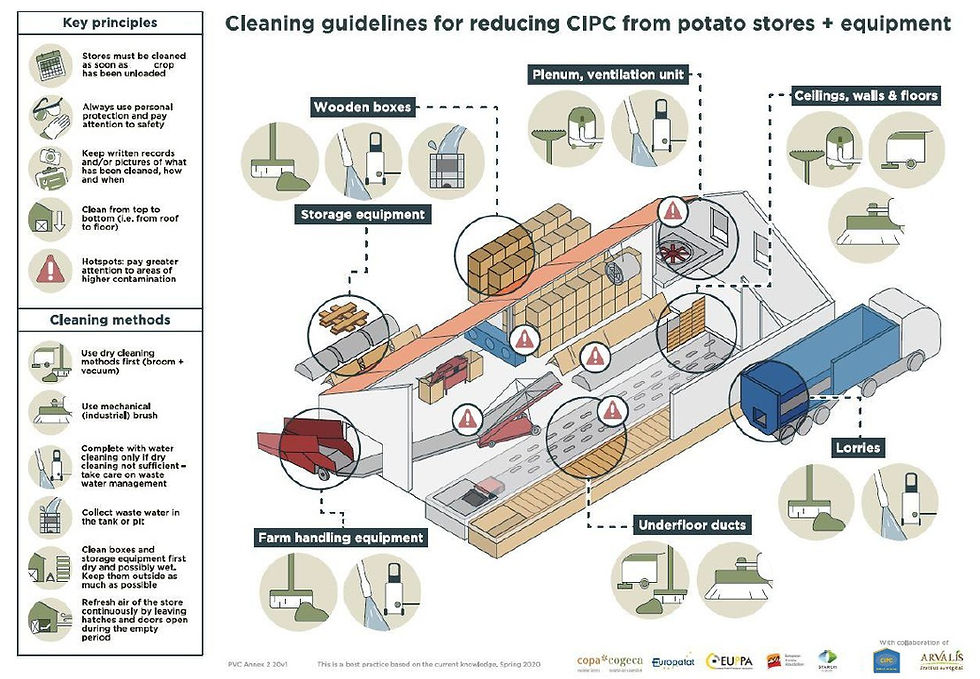
CONTINUE TO CLEAN STORES PREVIOUSLY TREATED WITH CIPC FULLY
Chlorpropham (CIPC) lost its approval in January 2020. As a non-approved product any residual chemical still in previously treated stores is considered a contaminant.
Fortunately, due to the diligence of our industry in testing for residues, we have a temporary MRL for residual CIPC at a level of 0.35 mg/kg which allow us to use any stores where low levels still persist. But the release of CIPC can take place over an extended time period and is influenced by multiple factors, both physical and environmental.
It is therefore our obligation, as store owners/operators, to continue to clean previously-treated stores to remove any residual chemical from the store fabric, concrete or ventilation systems. Please therefore ensure that you continue cleaning stores that were previously treated with CIPC thoroughly.
This infographic highlights key actions that HSE considers important for on-going removal of CIPC residues:
Technical insight
DON'T BE COMPLACENT ABOUT BLIGHT!
In a year where (late) blight (Phytophthora infestans) has not really been its usual threat for many, it is important not to slip into complacency just as disease pressure is increasing, with full Hutton alerts reported extensively in recent days.
The hot, muggy, wet weather we have been experiencing could be sufficient to trigger a late infection and - from a storage perspective - what we don't want are any spores that could be sufficiently mobile to wash down into the soil and create a tuber blight issue. Maintaining a full blight spray programme right up to harvest is crucial to keep blight at bay. Always consult your BASIS qualified advisor when seeking approval for use of a chemical treatment.
MALEIC HYDRAZIDE TREATMENT
Those storing long term will do best to discuss the potential for maleic hydrazide treatment with their BASIS qualified advisor.
Maleic hydrazide has become an important component of our sprout suppression armoury as it provides an element of residual sprout control. This is where the chemistry we apply gives control of any growth between applications of contact action products, such as 1,4-DMN, spearmint oil and orange oil. This residual control can be crucial if we are looking to achieve long term control of sprouting in a processing crop, for example.
Application conditions are an important consideration for the product as the MH relies on being taken up by the potato plant and being translocated to the tubers. Use of high volumes of water and application in moderate temperatures (e.g. in the evenings when humidities are higher) can assist uptake.
Reports suggest that not all crops will be able to be treated with MH as intended this season. Early applications of alternative sprout control products may therefore be required in the event of early dormancy break.
Year 2 CIPC target met!
It is a great relief to me, as Chair of the CIPC Residue Monitoring Group, that the Group has finally met its target of 125 CIPC data points from residue monitoring tests undertaken in 2024/25. It has done so with just a few weeks remaining ahead of the 31 July deadline for data submissions.
This means the Group will be able to submit its year 2 report to PSD in September without a repeat of the first year's shortfall on sample numbers. I am grateful to all those who took the time to submit data and hope we can call on your assistance again in year 3. Maybe we can try to avoid running it down to the wire next time?
The new report's preparation is underway and will look to support the continued need for a temporary maximum residue level for chlorpropham to enable stores with low levels of historical residue contamination to continue to be used for potato storage. However, this does not in any way remove the need for continued vigilance of the residue issue. Where there is evidence of residues remaining, focus should be maintained on cleaning measures for the new season - see our Best Practice section above.
Andy Curtis of the PPA has stepped aside as Group Secretary after two years in the role, handing over to Graham Bannister of GB Potatoes. Andy will remain on the Group as a key contributor to its work, especially on liaison with the processing sector not only within the UK but across Europe too.
AC
British Potato Industry Awards
A reminder that British Potato Review magazine is promoting the BPIA event to be held on the evening of 19 November at the Majestic Hotel in Harrogate. It has provided the following information as they seek further nominations for the ten categories ahead of the submission deadline of 4 September:
Award Categories
How to enter: To be considered, forms must be fully-completed and contain as much information as possible so judges can make informed decisions. We don't want anyone to miss out, so please be sure to include full contact information on any entry forms you complete, along with the name and details of who you are nominating (even if you are nominating yourself or your own company/organisation). Photos, logos, videos and any other type of illustration (eg. graphs, charts etc) can help to increase understanding and showcase why something is award-worthy, so please include wherever possible. You can also provide URLs to websites or online articles if you wish.
There is no limit to how many entries you make or how many categories are entered, providing all entries are relevant and full information given. More than one entry can also be made for the same company within individual categories if relevant and applicable.
Snippets
The Fight Against Blight initiative which independently assesses blight samples has confirmed that a sample from a trial site in Wales was the new EU46 variant of blight indicating that the strain overwintered from last season. It is the third confirmed case in the UK, following two discoveries confirmed in September 2024; those samples contained DNA mutations that conferred resistance to CAA & OSBPI chemistry.
World Potato Markets has reported that JR Simplot and Belgian processor Clarebout are planning to merge to create a processor to vie with Lamb Weston as the world's second largest French fry make behind McCain. https://worldpotatomarkets.com
Nuffield scholar Harry Barnett of Holkham Emerald has published his report entitled 'How to counteract the agronomic and market challenges facing the UK potato industry', sponsored by McDonalds and the Royal Norfolk Agricultural Association. It is downloadable from the Nuffield Farming Scholarship website.
Storage equipment suppliers around the country are reporting good demand for new storage systems for the coming season, bucking the trend of the last few years, as growers committed to key markets look to improve their storage capability.
Forthcoming events
If you are hosting a potato or agricultural industry event, please send details to admin@potatostorageinsight.com. Key dates for your diary with relevance to the potato sector in the coming months in UK and Europe include:
July
Thu 31 WCM Potato Trials Day 2025
at Low Grange Farm, Market Weighton, Yorkshire. YO43 3PZ
August
Tue 5 CUPGRA Members' Day #2, Cambridge
Park Farm, Histon, Cambridge CB24 9NZ
Thu 7 Potatoes in Practice. James Hutton Institute, Dundee.
Wed 20 Eurofins Potato Demonstration
Poplars Fm., Barrow-upon-Trent, DE73 7HJ. w3w///solves.foods.neatly. 9am - 4pm
Wed 27 - Thu 28 UK Breeders' Potato Variety Days 2025
Caythorpe Farms, Lincolnshire. NG32 3EZ
September
Tue 2 PSI One Day Store Management Course, Rutland.
Places available. See details above.
Wed 3/ Potato Europe
Thu 4 Annual international working exhibition, Lelystad, The Netherlands
November
Wed 19 - Thu 20 BP2025 - the British Potato Event, Yorkshire Event Centre, Harrogate
Exhibition, seminars and industry awards dinner on the Wednesday evening. Save the date!
Details from: bpinfo@warnersgroup.co.uk
December
Tue 9 - Wed 10 CUPGRA Conference, Cambridge
Please note that you, or a colleague, can subscribe to Synopsis at any time by going to potatostorageinsight.com and clicking on SUBSCRIBE. We can also now take payments by credit card. Call Adrian on +44 (0)7970 072260 if you have any questions.
Subscriptions: we issue invoices as individual subscribers reach the anniversary of their payment. A full year's subs is great value at just £9.50/month (£114 + VAT per annum), so please renew promptly. Unpaid subscriptions will be closed within 8 weeks of invoice issue. Thank you.
Synopsis is written by Adrian Cunnington and published by Potato Storage Insight Ltd., 45 Main St., Gedney Dyke, Spalding, PE12 0AJ. UK.
© Potato Storage Insight Ltd. 2025
Comments